It's possible to know a lot about nutrition and still feel stuck every time you're standing in front of the fridge or scanning a menu. That gap between knowledge and decision-making is one of the most common frustrations people run into — and it's rarely solved by learning more facts. It's usually solved by simplifying the decision itself.
Most decisions don't need to be complicated
A lot of everyday food choices get treated like high-stakes decisions, when in reality they're fairly low-stakes and reversible. What you eat at lunch today has very little bearing on your health next year. Treating each individual choice as though it carries enormous weight tends to create decision fatigue, and decision fatigue is exactly what leads to reaching for whatever's easiest, regardless of whether it's what you'd actually choose with a clear head.
A simple filter instead of a long list of rules
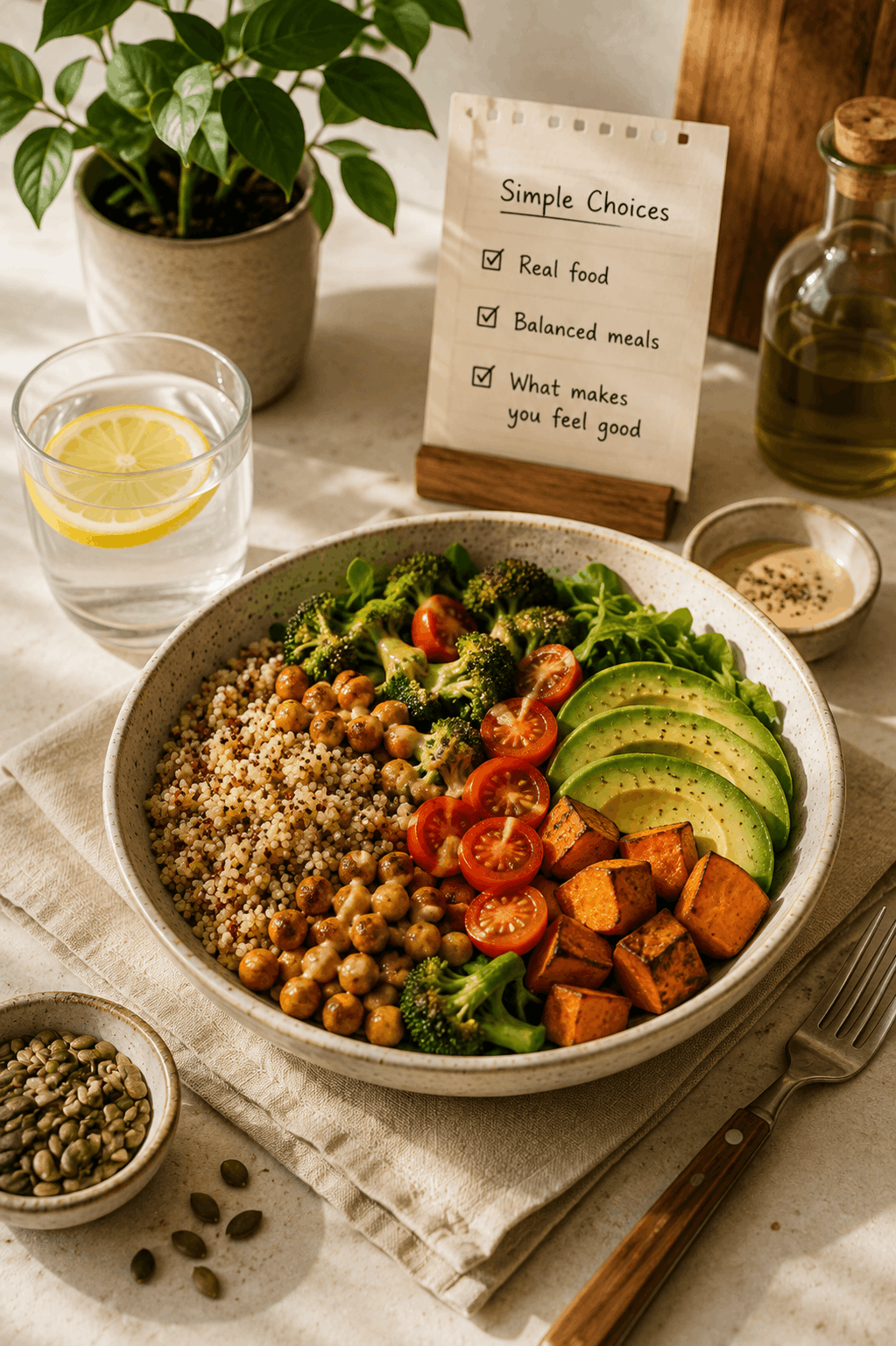
Rather than trying to remember a long list of do's and don'ts, it can help to ask a single, simpler question: does this choice generally move me toward more real food, more balance, and more of what I actually want to feel like afterward? That one question does most of the work that a complicated rulebook tries to do, without requiring you to memorize anything.
This kind of filter also removes a lot of the moral weight that tends to attach itself to food. A choice isn't 'good' or 'bad' in an absolute sense — it's just one data point in a much longer pattern, and no single point needs to carry that much significance.
Reducing the number of decisions you make
One underrated way to make healthier choices easier is to simply make fewer of them. Repeating a similar lunch during the work week, keeping a short default grocery list, or choosing the same two or three go-to options at a regular restaurant all reduce the number of times you have to actively decide something from scratch.
- Use a simple question to guide choices instead of a long list of rules.
- Reduce the number of times a day you have to decide something new.
- Remember that any single meal carries very little weight on its own.
What to do when a choice still feels hard
Some decisions will still feel harder than others, no matter how much the framework is simplified — a work lunch with limited options, a family gathering with food you didn't choose, a day when nothing sounds appealing. In those moments, it can help to lower the bar even further: instead of asking what the ideal choice would be, ask what a reasonable choice looks like given the actual options in front of you. Reasonable, repeated often, tends to outperform ideal, attempted occasionally.
It also helps to remember that the goal isn't to remove all difficulty from every decision forever. Some choices will always take a bit more thought than others. The aim is simply to reduce how many decisions require that level of thought, so that the ones that do come up don't feel exhausting on top of everything else.
Healthier eating, in practice, has less to do with having more nutrition knowledge and more to do with lowering the mental cost of each decision. The less overthinking a choice requires, the more likely you are to make it again tomorrow — and that repetition is where the real benefit comes from.

This article provides general educational information and is not a substitute for individualized medical advice. Always consider your own circumstances, and speak with a qualified professional about decisions specific to your health.