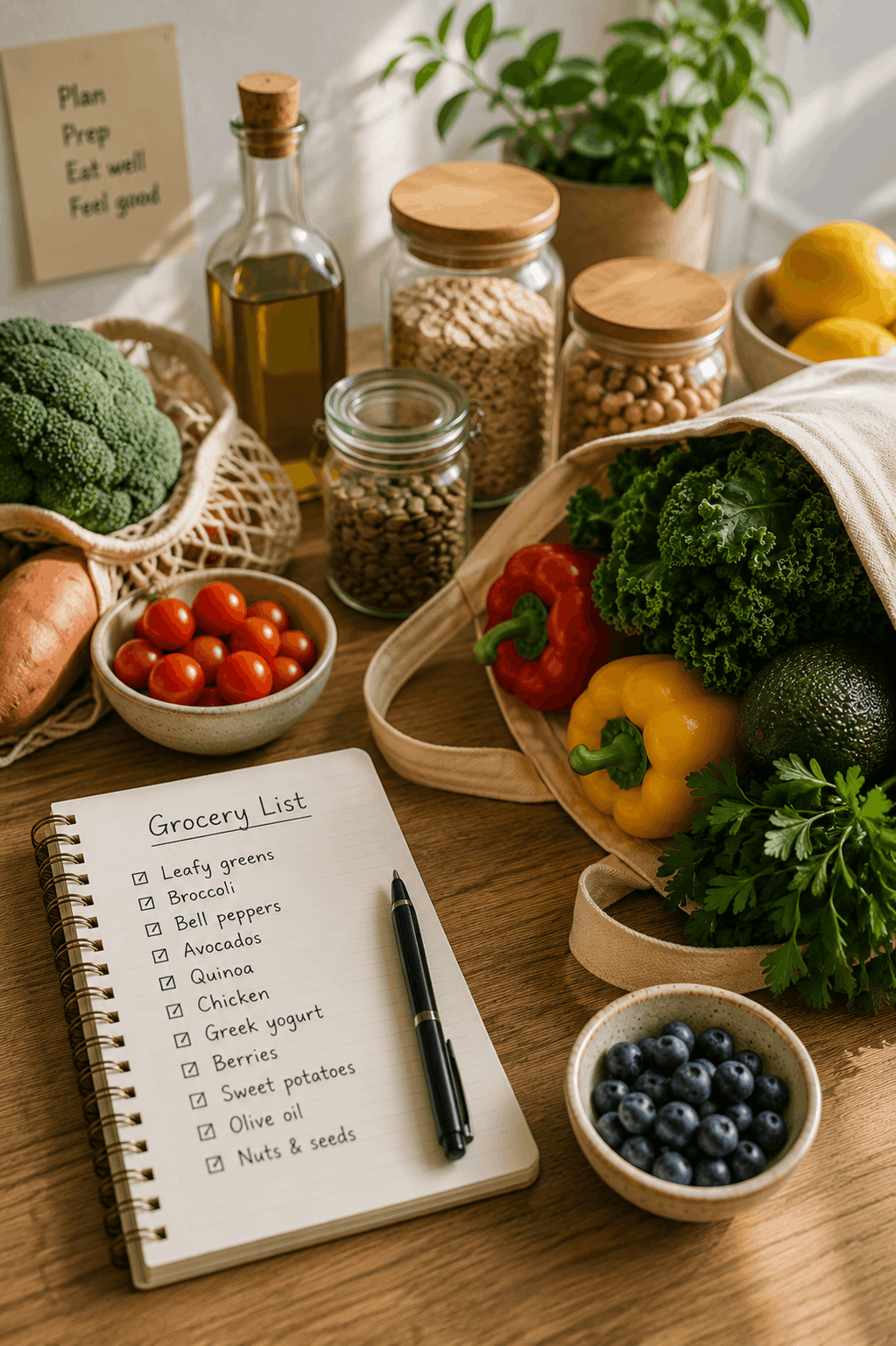
Most decisions about what you'll eat this week aren't actually made at mealtime — they're made earlier, at the grocery store. Whatever ends up in the cart is largely what ends up on the plate, which makes the grocery list one of the most underrated tools for making healthier eating feel automatic rather than effortful.
Shop for the pattern, not just the recipes
It's tempting to build a list around a handful of specific recipes for the week, but that approach tends to fall apart the moment plans change — a night out, a busy evening, a recipe that turns out to need an ingredient you don't have. A more durable approach is to shop for a general pattern instead: a few proteins, a rotation of vegetables, a couple of whole grains, and some fruit. From there, meals can be assembled loosely from whatever's on hand, rather than depending on a specific plan holding up perfectly.
Let the list do the deciding in advance
One of the quiet benefits of a grocery list is that it moves food decisions to a calmer moment, away from a hungry evening or a chaotic afternoon. Whatever thought goes into building the list once, at the store, doesn't need to be repeated every night at dinner. The harder thinking happens once a week; the easier thinking happens every day after.
Keep a short list of staples that never really changes
Alongside whatever varies week to week, it helps to have a small set of staples that show up on almost every list without much thought — eggs, oats, a favorite fruit, a couple of vegetables you know you'll actually eat. These aren't exciting, but they're reliable, and reliability is exactly what makes a healthier default easy to maintain, even during a busy or distracted week.
- Build the list around a general pattern of foods, not specific recipes.
- Keep a short, repeatable set of staples that shows up most weeks.
- Do the harder thinking once, at the store, instead of every night at dinner.
Leaving room for flexibility, not just efficiency
A list built around a pattern rather than fixed recipes also leaves more room for whatever actually looks good at the store that week. If the vegetables you'd planned for don't look fresh, or something else is on sale, a pattern-based list makes it easy to swap one vegetable for another without throwing off the whole plan. A recipe-based list doesn't flex nearly as well, since substituting one ingredient can mean an entire dish no longer works the way it was intended to.
This flexibility matters more than it might seem. Grocery shopping happens under real conditions — limited time, limited selection, a cart that's already getting full. A list that can absorb small changes without falling apart is simply more realistic to use week after week than one that depends on everything going exactly to plan.
What this changes at home
When the kitchen is stocked around a simple, repeatable pattern, the easiest option at home tends to also be a reasonably balanced one — because that's simply what's available. This is a much lighter lift than trying to exercise willpower at every meal. The grocery list, done well, does a lot of that work in advance, long before hunger or a busy evening ever enters the picture.
None of this requires a perfect list or a rigid weekly ritual. It just requires giving a little more thought to what comes home from the store, since that one decision quietly shapes most of the ones that follow.

This article provides general educational information and is not a substitute for individualized medical advice. Always consider your own circumstances, and speak with a qualified professional about decisions specific to your health.