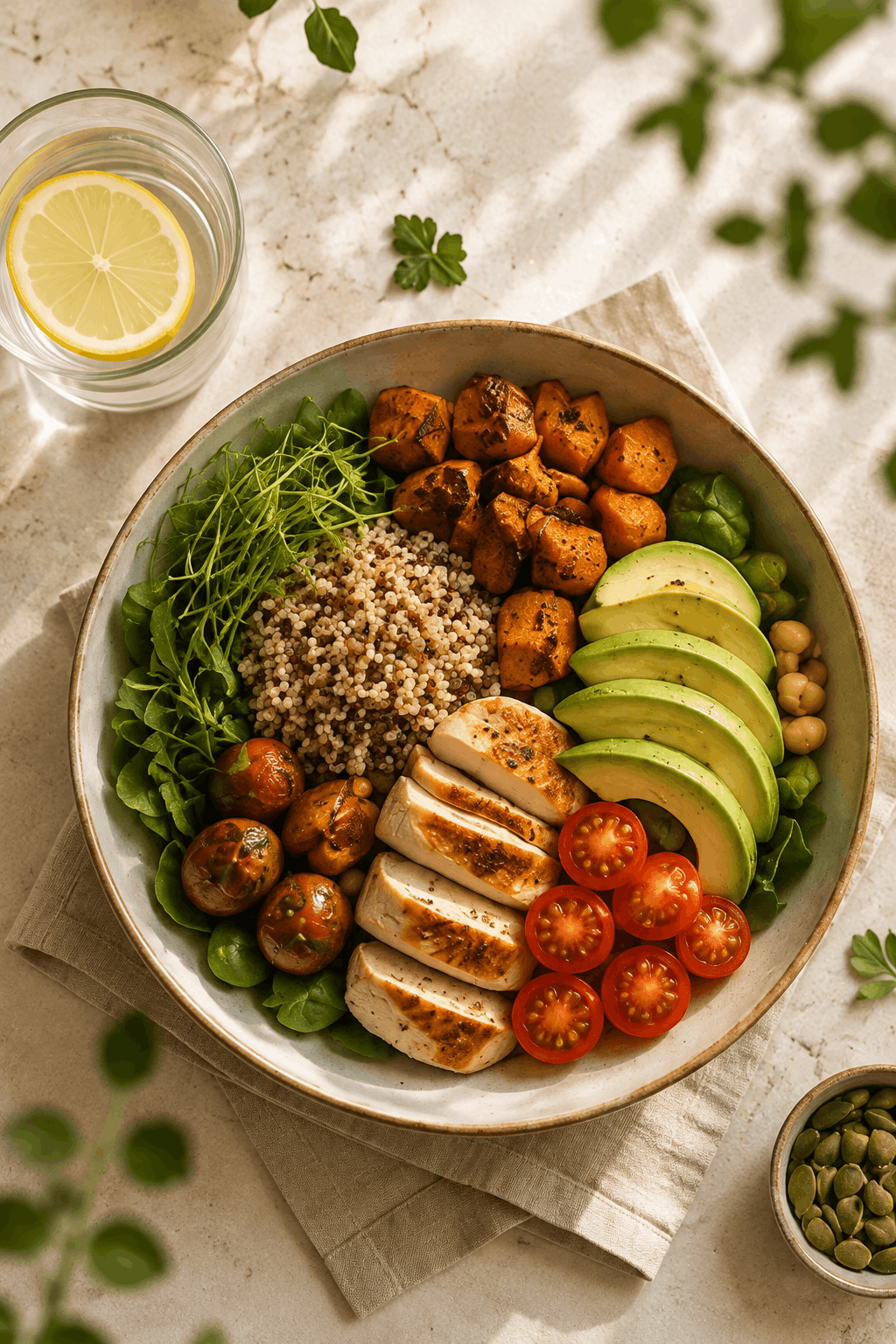
Most people don't need a stricter set of rules around food — they need a simpler way to make decisions at mealtime. That's the idea behind thinking in terms of a plate, rather than a list of foods to avoid or a running tally of numbers. It's less about precision and more about proportion.
Start with the shape of the plate, not the rules
Picture your plate divided into three loose sections. About half is filled with vegetables or fruit. A quarter holds a source of protein — beans, eggs, fish, poultry, tofu, or meat, depending on what you eat and enjoy. The last quarter is for whole grains or starchy foods like rice, potatoes, or bread. That's the whole framework. No weighing, no counting, no separate rules for different foods.
The value of this approach is that it travels with you. It works at a restaurant, at a family dinner, or when you're assembling something quick on a weeknight. You're not trying to remember whether a food is 'allowed' — you're just noticing what's already on your plate and adjusting the balance a little.
Why proportion works better than restriction
A lot of nutrition advice focuses on subtraction: cut this, avoid that, eliminate the other thing. In practice, that approach tends to create a lot of mental friction, and friction is exactly what makes healthy eating hard to sustain. Thinking in proportions instead of prohibitions removes a layer of decision-making. You're not asking 'is this good or bad,' you're asking 'what else is on the plate.'
This also makes room for real life. If a dinner leans heavier on starch one night, that's not a failure — it's one meal, and the next one is a chance to bring the balance back. The plate framework isn't a scorecard. It's closer to a compass, something to orient toward rather than a target you either hit or miss.
Making it work for how you actually eat
Not every meal fits neatly onto a single plate — soups, stir-fries, and sandwiches don't always divide themselves into thirds. In those cases, the same proportions still apply loosely: notice whether vegetables, protein, and carbohydrates are all represented in reasonable amounts, rather than trying to force a visual division that doesn't fit the food.
- Add a vegetable side to meals that don't naturally include one, like pasta or sandwiches.
- Choose a protein source you actually enjoy, so it's easier to include consistently.
- Let grains and starches fill in the rest, without treating them as something to minimize.
Adjusting the formula to fit your own appetite
The proportions described here are a starting reference, not a fixed rule that applies identically to everyone. Someone with a physically demanding day might naturally want a larger portion of grains or starches; someone else might prefer a plate that leans more heavily toward vegetables and protein. The value of the framework isn't in its precision — it's in giving you a shape to adjust from, rather than starting every meal with no reference point at all.
It also helps to remember that this is meant to describe a typical meal, not every meal without exception. A holiday dinner, a slice of birthday cake, or a plate that's mostly one thing because that's what sounded good that day, don't need to be measured against this framework at all. It's a tool for the ordinary, everyday meals that make up most of the week — not a standard to hold every single plate to.
Over time, this kind of proportional thinking becomes less of a conscious calculation and more of an instinct — the same way a cook eventually stops measuring and starts eyeballing. That's really the goal: a way of building a meal that feels natural enough to repeat, meal after meal, without needing a new plan every time.

This article provides general educational information and is not a substitute for individualized medical advice. Always consider your own circumstances, and speak with a qualified professional about decisions specific to your health.